Wednesday, January 19, 2011

Community Supported Agriculture "What You Want, When You Want It!"

Farmers' Mark and Joanie are excited to announce the 2011 CSA. A CSA (Community Supported Agriculture) is a program where we offer customers fresh-picked USDA Certified Organic produce by purchasing a share of the season's harvest in advance.
By participating in a CSA, customers become dedicated to sustaining the farm by supplying capital for start-up expenses, (farm labor, seeds, potting soil, utilities, greenhouse supplies, etc.) that need to be paid before the first crop is harvested.
This year a share entitles our members to fresh produce, vegetable, flower and herb plants, fresh cut flowers and all other products available in our farm store (honey, maple syrup, goat cheese and goat soap, jams, baked goods, seasonally prepared foods, etc.). Members will be able to choose what's in their share anytime the farm store is open from May through October.
We strive for a wide variety of USDA Certified Organic produce throughout the season. A major benefit to this program is its flexibility. You select what you want, when you want it!
Visit our website today for additional details about our CSA and to download your enrollment application!

Wednesday, September 15, 2010

Food Focus: a variety of Winter Squash

Our winter squash laying out in the greenhouse, curing.

Winter squash is the fall harvest storage vegetable. Winter squash will store three to six months, depending on the variety, in a cool, dry, well-ventilated area. All varieties are great for baking, roasting and pureeing. Once squash is cooked, it can be used in soups, main dishes, vegetable side dishes, even breads, muffins, custards & pies. Any type of mashed or pureed winter squash can be used in place of canned pumpkin.

Winter Squash is rich in vitamin A, beta-carotene, vitamin C, potassium and dietary fiber. It has powerful antioxidant and anti-inflammatory properties.

These are some of the USDA Certified Organic varieties you will find at our farm store and farmers' markets:


HONEY BEAR, a mini-acorn squash is just the right size halved for single servings. It is deliciously starchy and sweet.


ACORN SQUASH is a small, ribbed squash; it has a pale yellow flesh and is deliciously starchy and sweet.

It is delicious right from the garden and best eaten within 3 months of harvest. Acorn squash is ideal for baking, but can also be sauteed or steamed.

To bake simply cut acorn squash in half, remove any seeds, add butter and bake at 350 degrees 45 to 60 minutes until squash is tender. Store in a cool dry place such as a cellar.


KABOCHA is a Japanese variety, that refers most commonly to a squash of the buttercup type. It is like a buttercup without the "button" on the blossom end.


This squash has a green, bluish-gray (Grey Kabocha) or a deep orange (Scarlet Kabocha, pictured above) skin. The tender flesh is deep yellow to bright orange, smooth and sweet for baking, mashing & pies.


Usually a tear-drop shape, HUBBARD SQUASH are often used as a replacement for pumpkin. Hubbard squash are good for pies and purees.

Hubbard squash can be cooked whole, but are generally peeled and boiled, cut up and roasted, or cut small and steamed or sauteed. The yellow flesh of these tend to be very moist and longer cooking times in the oven are needed.

Hubbard squash, if in good condition initially, can be successfully stored six (6) months at 50 to 55 degrees F. with 70% relative humidity. Less rot will develop in the Hubbard Squash if stems are completely removed before storage.


BUTTERNUT SQUASH usually have a tan skin. The "oranger" the color, the riper, drier, and sweeter the squash. The bright orange, moist flesh tastes best after a few weeks storage.

Butternut is a more watery squash and tastes somewhat similar to sweet potatoes. Its choice, fine-textured, deep-orange flesh has a sweet, nutty flavor. Some people say it is like butterscotch.

Butternut is a common squash used in making soups because it tends not to be stringy.

It has the longest storage potential of all squash; it will keep all winter.


SPAGHETTI SQUASH is a small, watermelon shaped variety ranging size from 2 to 5 pounds or more. It has a golden-yellow, oval rind and a mild, nut-like flavor. When cooked, the flesh separates in strands that resemble spaghetti pasta.

The yellowest Spaghetti squash will be the ripest and best to eat. Although it may seem counterintuitive, larger Spaghetti squash are more flavorful than smaller ones.

To prepare Spaghetti squash, cut in half lengthwise and remove the seeds, then bake or boil it until tender. Once cooked, use a fork to rake out the "spaghetti-like" stringy flesh (all the way to the rind) and serve.

Spaghetti squash can be stored at room temperature for about a month. After cutting, wrap in plastic wrap and refrigerate up to two (2) days. Spaghetti squash also freezes well.


BUTTERCUP SQUASH is one of the most common varieties of winter squash with a turban-shape (a flattish top and dark green skin), and normally heavy (weighing 3-5 pounds), with dense yellow-orange skin.

It has a sweet and creamy orange flesh. This squash is much sweeter than other winter varieties. Buttercup squash can be roasted, baked, mashed, pureed, steamed, simmered, or stuffed.

It can be used like pumpkin and can replace sweet potato in most recipes.


SWEET DUMPLING is a small, mildly sweet-tasting squash resembling a miniature pumpkin with its top pushed in. It has a cream-colored skin with green specks or can be multi-colored like the Carnival (pictured left).
It has sweet and tender orange flesh and is a great size for stuffing and baking as individual servings. Sweet dumplings are tiny but great for roasting and presenting whole.


DELICATA is an heirloom variety and is one of the tastier winter squashes, with creamy pulp that tastes like corn and sweet potatoes.
Delicata can be baked or steamed. The thin skin in also edible.

Monday, August 2, 2010

USDA Certified Organic Flower Bouquets


Our farm store has fresh USDA Certified Organic Mixed Flower and Sunflower bouquets. The flowers are harvested and bouquets are made on Tuesday mornings and will be available in the farm store on Tuesday afternoons.
We also harvest flowers on Friday mornings. Bouquets are available at the farm store and at the Litchfield Hills Farm Fresh Market on Saturday's from 10am-1pm.
While bouquets last!
Keep your flowers fresher longer with our Flower Power Recipe:
  • 1 tbsp. sugar (food source)
  • 1 tsp. bleach (anti-bacterial)
  • 1 tsp. lemon juice or vinegar (lowers pH & aids in water uptake)

Thoroughly mix above ingredients in vase of water. Re-cut stems using a knife to avoid smashing stem. Change water and re-cut stems every few days.

*Priscilla Russo and her husband Lou are CSA "work shares" at the farm. When they are not on the farm, they run Russo Photography together. Priscilla has been kind enough to share some of her photos with us for our website and blog. Thank you Priscilla and Lou!

Tuesday, July 20, 2010

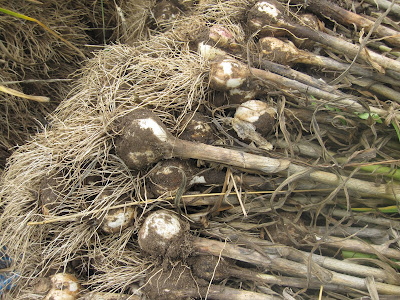
The Great Garlic Harvest!

The happy harvesters from left to right - Ben, Farmer Mark, Selah, Ally, Farmer Joanie, Mary, Katy, Molly; and down in front - Caleb a/k/a "Big Tuna"

Everyone is lined up on either side of the garlic bed. The soil has been loosened; they are pulling up the bulbs, shaking off some of the dirt and stacking the garlic on pallets.

Next, the garlic will be bunched and hung to cure for two to three weeks.

Fun Facts about Garlic:
  • The first known labor strike was over garlic. Slaves forced to build the great Egyptian pyramids refused to work without a daily garlic ration.
  • At ancient Greek and Roman weddings, the brides carried bouquets of garlic and other herbs instead of flowers.
  • Garlic is a member of the onion family which also includes leeks and shallots.
  • Garlic is considered both a vegetable and an herb.
  • The first recorded writings of garlic were in Sanskrit in 5000 B.C.
  • On-going medical research is confirming all the old wives tales about the benefits of eating garlic. Regular consumption of garlic reduces bad cholesterol and increases good cholesterol, helps fight respiratory infections, improves circulation and so much more.
  • To remedy "garlic breath" try chewing a little raw parsley, a lemon wedge or drink green or mint tea.

Thursday, July 15, 2010

Farm Store Update

We have USDA Certified Organic Apple Mint, Basil, Blackberries, Cauliflower, Collards, a variety of Cucumbers including marketmore, picklers and asian (burpless), eggplant, garlic scapes, kale, kohlrabi, a variety of Lettuces, New Zealand Spinach, Parsley, Peppers, Raspberries, Scallions, Shallots, a variety of Summer Squash and Zucchini, Swiss Chard, and our very own greenhouse Cherry and Regular Tomatoes.

We also have Conventional Corn and Conventional Peaches from March Farms.
Our USDA Certified Organic produce can be found at our farm store
located at 541 Albany Turnpike (Route 44) in Canton, CT.
You will also find us at:
Litchfield Hill's Farm Fresh Market, Saturday's 10am-1pm
Canton/Collinsville Farmers Market, Sunday's 10am-1pm
Windsor Farmer's Market, Thursday's 3:30pm-6:30pm

Wednesday, July 14, 2010

Food Focus - Kohlrabi

Kohlrabi tastes like a sweet turnip with a bit of a radish tang. Grate kohlrabi raw into salads, or make a coleslaw like this Kohlrabi slaw:
  • 1 1/2 lbs. kohlrabi, peeled and shredded (about 4 c)
  • 2 medium carrots, shredded
  • 2 tbsp minced onion
  • 1/3 cup sour cream
  • 1/3 cup mayonnaise
  • 1 tbsp dijon mustard
  • 2 tbsp lemon juice
  • 2 tbsp each chopped fresh dill & chopped fresh parsley
  • Black pepper to taste
  1. In a bowl, blend onion, sour cream, mayonnaise, dijon mustard, lemon juice, dill, parsley and pepper.
  2. Add kohlrabi and carrots and toss to coat. Serve, or chill 1 hour before serving. Enjoy!

Or, make Steamed kohlrabi with lemon butter:

  • 1 bunch kohlrabi
  • 2 tbsp butter
  • 1 tbsp lemon juice
  • 1 clove garlic, minced
  • 1 tbsp minced frash parsley
  • salt and pepper to taste
  1. Trim kohlrabi, but do not peel. Steam over simmering water, covered, 40 minutes or until tender.
  2. Cool slightly, then peel and chop.
  3. In saucepan, melt butter over medium heat; stir in lemon juice, garlic, and parsley. Cook 2 minutes.
  4. Add kohlrabi; toss to coat. Season with salt and pepper. Serve and Enjoy!

You can also add sliced or cubed kohlrabi to hearty soups, stews, or a mixed vegetable stir-fry; mash cooked kohlrabi, mix with cooked potato, form into patties, and fry in butter. Try raw kohlrabi, thinly sliced, alone or with a dip. Peel kohlrabi and eat it raw like an apple.

Kohlrabi offers generous amounts of vitamins A and C, and emphasizes the minerals potassium and calcium. It's high in fiber and contains only 40 calories per cup.

Monday, July 12, 2010

Food Focus - New Zealand Spinach

New Zealand Spinach is not a true spinach but a warm season alternative to regular spinach. It thrives in hot weather and will not bolt or get bitter like true spinach. It has similar flavor and texture properties to spinach and is cooked like spinach. New Zealand Spinach does have a high oxalate content - it contains antioxidant carotenoids that are responsible for much of its nutrition. Because of the form they are in, it is harder for the body to digest them. By blanching the leaves, the nutrients can be converted to a form the body can easily absorb. New Zealand Spinach is valued because of its high vitamin C content. It is a good source of vitamin A, vitamin B1 and vitamin B2 and is low in fat and fiber content. Use New Zealand Spinach raw as a salad green or in any of your favorite spinach dishes, like this:

Quinoa Stir-Fry with Spinach and Walnuts:
  • 1 cup quinoa
  • 2 tbsp extra-virgin olive oil
  • 1 tsp minced garlic
  • 1/2 tsp sea salt
  • 1/2 cup walnut pieces
  • 1 bag (6 oz.) fresh baby spinach or New Zealand Spinach
  • 1 cup grape or cherry tomatoes
  • 1/2 cup freshly grated parmesan cheese
  • Torn fresh basil leaves (garnish)
  1. Place quinoa in small bowl, add water to cover, and swish to rinse. Pour into fine mess strainer and drain well.
  2. Heat oil in medium skillet. Add quinoa. Toast, stirring, over medium heat until golden, about 10 minutes. Add garlic and cook, stirring, 1 minute. Add salt and 2 cups of water. Heat to a boil. Cover and cook over medium-low heat until water is absorbed, about 15 minutes.
  3. Spread walnuts in small skillet and stir over medium-low heat until toasted, about 5 minutes. Set aside.
  4. When quinoa is cooked, add spinach and tomatoes to skillet. Stir-fry over medium heat until spinach is almost wilted and tomatoes are warmed, about 1 minute. Stir in walnuts and cheese. Garnish with basil leaves. Serve warm. Enjoy!